The Noticeboard Outside the Venue and the Changing Life of Local Cultural Information
A venue noticeboard can preserve local cultural memory: learn how to record changing posters, share overlooked histories and keep a useful paper trail.
A venue noticeboard can become a small archive when someone records what appears on it, not just what is on tonight. The venue noticeboard sits between fleeting promotion and local cultural memory: a poster disappears, but its image, date and context can still tell a story about who made performances and gatherings possible.
That history is different from the venue’s official programme. It includes the amateur group borrowing a rehearsal room, the fundraiser for a neighbourhood project and the handwritten correction that shows how plans changed. Treating the board as a living record means preserving those traces without leaving outdated paper on display.
A venue noticeboard records activity beyond the stage
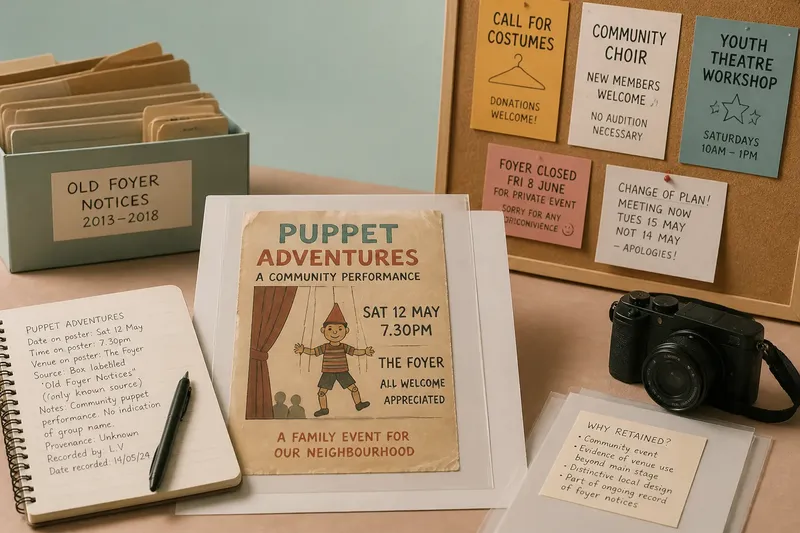
A formal programme tends to name productions, artists and dates. A noticeboard can show the supporting life around them: a call for costume donations, a community workshop, a local choir seeking new members or a notice about a shared event in the foyer.
That variety matters because small activities may leave little documentation elsewhere. A group might not appear in a venue’s annual report or professional archive, yet its poster can reveal that people used the building for more than performances. The board captures invitations and practical needs as well as finished events.
It is not a complete record of neighbourhood culture. Some groups never submit notices, and a board reflects whoever has access to it and whoever maintains it. Its value lies in making those limits visible rather than pretending that a handful of posters represents everyone.
Paper details reveal how a venue’s cultural life changes
Posters carry more than event titles. Their wording, design, paper, logos and contact details can point to changing technologies, collaborators and ways of organising. A handwritten phone number beside a printed programme, for instance, preserves the practical character of an invitation in a way a clean listing may not.
Repeated names can be revealing, too. A local group appearing across several seasons may suggest an ongoing relationship with the venue; a one-off notice may mark a short-lived project. Those clues need context, so record what is visible and avoid guessing at motives or attendance.
Imagine a volunteer archivist finding a faded poster for a neighbourhood dance evening in a folder. They photograph it, note the event title and date printed on the page, and ask the venue whether the group’s name appears in old programme files. The result is a record that links one ephemeral notice to a possible wider history, while clearly separating confirmed details from unanswered questions.
Keep an archive separate from the active display
Outdated notices should come down from the public board, but removal need not mean disposal. A simple archive can preserve the items that help explain the venue’s changing cultural life, without turning the display into an unreadable wall of old paper.
For a modest paper record, use acid-free folders or sleeves where available, keep pages flat and dry, and avoid adhesive tape on original posters. Store photographs and scans with useful filenames rather than relying on a phone’s camera roll. If a poster is fragile or valuable, ask a local archivist or conservator for suitable handling advice.
Record a few consistent details for each item:
- If the poster gives an event title and date, record both; if either is missing, mark it as unknown rather than filling the gap by guesswork.
- If a venue or group is named, copy the spelling as printed; if the name is unclear, add a note that it needs checking rather than silently correcting it.
- If the item has a distinctive design or handwritten amendment, photograph those details; if the image would expose private contact information, restrict access or redact the copy intended for public use.
- If the poster’s source is known, note who supplied it and when; if not, record that its provenance is unknown rather than inventing a chain of ownership.
- If permission to reproduce the design is clear, consider sharing a scan; if permission is uncertain, keep it for internal reference and seek advice before publishing it.
- If the paper is damp, brittle or damaged, avoid flattening it by force; if it continues to deteriorate, consult a qualified conservator before further handling.
What is not worth the effort is saving every scrap simply because it once sat on the board. Select items for their connection to the venue, their distinctiveness or their value as evidence, and keep a short note explaining why each was retained.
Recording a poster makes its context as important as its image
A scan without context can become a mystery. Was the notice on the board for a week or several months? Did it advertise a venue production, a partner event or a group using a room? A brief record of where it was displayed and how it came into the archive can answer questions the poster itself cannot.
Say a venue volunteer finds a poster for a community puppet performance in a box marked “old foyer notices”. The volunteer photographs the front, records the printed title and date, and adds that the box label is the only known source. If a later programme confirms the venue hosted the event, that confirmation can be added separately; until then, the archive preserves the clue without presenting an assumption as fact.
Where the record is uncertain, say so plainly. “Date unclear” is more useful than a confident guess, because future researchers can revisit the evidence without mistaking an inference for a fact.
Digital records need care as well as convenience
Digital images are easy to search and share, but they still need a sensible structure. Give files descriptive names, keep a separate index and preserve an unedited copy of the original image. If a scan is corrected for readability, retain the original alongside it and label the edited version.
Some posters include personal phone numbers, email addresses or names of individual volunteers. Before putting scans online, check whether those details are still appropriate to publish. A venue can make a lower-resolution or redacted public copy while keeping a restricted archival version, subject to its own policies and any relevant permissions.
Digital storage is not a substitute for all paper preservation. A clear scan captures appearance, but it may miss texture, material and marks on the reverse. For significant items, retain the physical object when its condition and available space allow, and seek professional advice if handling or storage is uncertain.
How should a venue noticeboard become part of an archive?
What details should be recorded from a poster?
Note the visible title, date, named organisers, venue connection, source and any handwritten changes. Mark missing or uncertain details clearly, so later readers can distinguish the poster’s evidence from an archivist’s interpretation.
Should every old notice be kept?
No. Keep items that add a useful record of the venue or its community, and note the reason for retaining them. If an item has little context or duplicates a better-preserved copy, follow the venue’s retention policy rather than accumulating paper without purpose.
Can a venue publish archived poster scans online?
It depends on permissions, copyright and the personal information shown. Check the venue’s policies and seek qualified legal advice where rights are unclear; a public copy can omit sensitive details when appropriate.
How can an archive show what is uncertain?
Use direct notes such as “date illegible” or “source unknown”, and keep later corrections separate from the original record. This makes the archive more trustworthy than a polished description that conceals gaps.
A venue noticeboard becomes a useful record when its scraps are preserved with restraint and honest context. The next time an old poster comes down, record what it actually says, where it came from and what remains uncertain; that small habit can leave future readers a clearer account of local cultural life.